The Boulder Is Heavier With an ADHD Brain
Managing the mental load of a household is hard. For women with ADHD, the fear of forgetting means the mental load never really gets to rest — and that takes a real toll. If this sounds familiar, you're not alone, and support is available.
Sisyphus pushed his boulder up the same hill every single day. No variation, no choice, just the boulder, the hill, and the eternity of doing it again.
Last month I wrote about motherhood as its own version of that myth — the invisible loop of noticing, holding, and carrying that never quite finishes. But there's a detailI left out. For some of us, the boulder doesn't just roll back down. It also changes shape, multiplies, and occasionally vanishes entirely, only to reappear at the worst possible moment.
That's what carrying the mental load looks like with an ADHD brain. I would know, because I'm one of the people doing it.
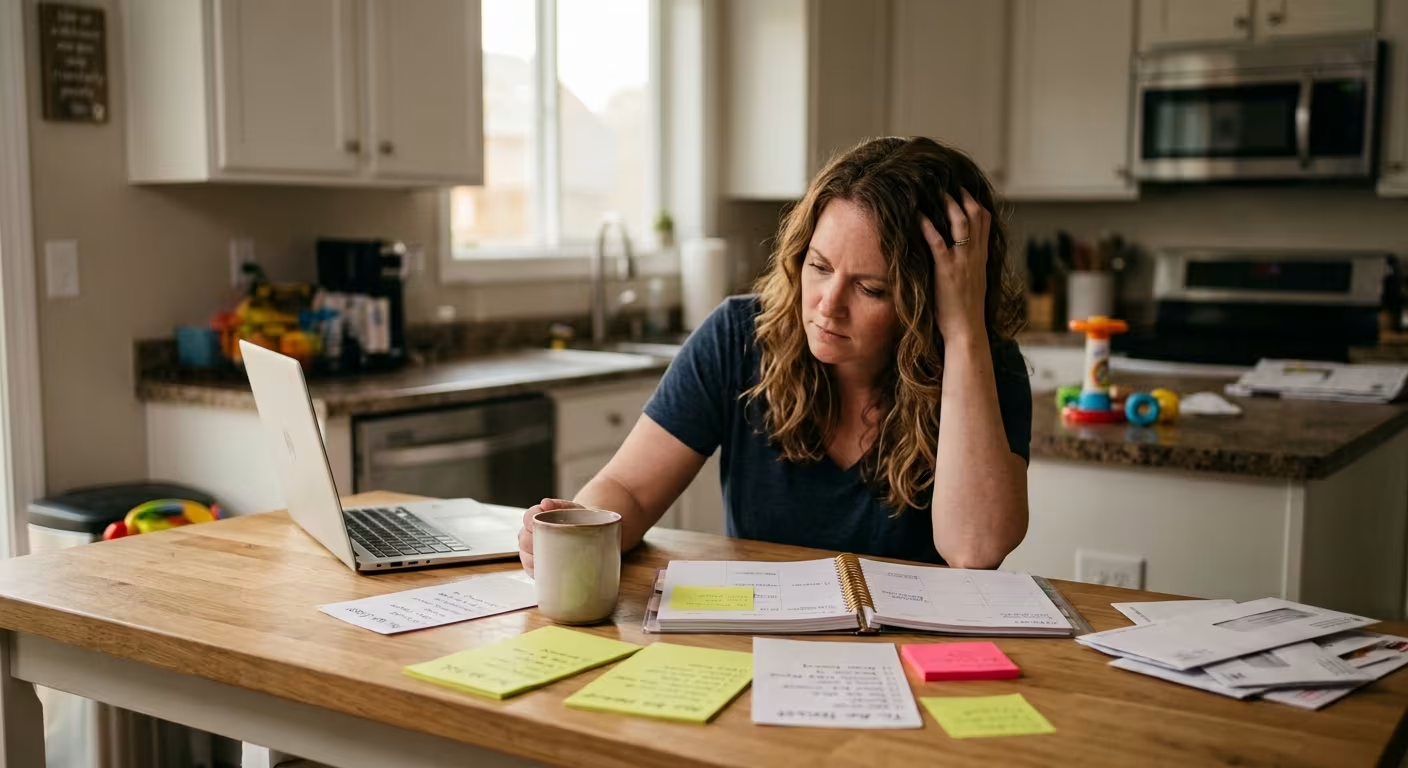
The best way I can describe it is this: imagine having a hundred browser tabs open at once. Some of them are running fine. Some of them are frozen. Some of them are buffering in a way that makes you think they're working, but they're not really loading. And a few of them, you genuinely cannot remember why you opened them in the first place.
That's my brain on a regular Tuesday.
Last week, I remembered that something needed to go on the grocery list. I told my husband, he was going to add it. Ten minutes later, I could not for the life of me remember what it was. I just knew, with absolute certainty, that it was important. The tab was open. The content was gone.
(I also know that a watermelon is 92% water. That information has been sitting in my brain, rent-free, for approximately 25 years. My brain decided that was worth keeping.)
This is the part that people don't always understand about ADHD: it's not that the brain doesn't care. It cares enormously. It's just wildly inconsistent about what it holds onto, and when, and for how long. It’s not truly a lack of attention but a dysregulation of it. Intense focus or none at all. My husband once yelled my name loudly as an experiment to attempt to get my attention while I was watching TV. I did not hear him. I wasn’t ignoring him, I truly did not hear him. Here's where it gets harder.
Mental load, as a concept, is already exhausting. It's the anticipating, the coordinating, the holding everything for everyone before anyone even thinks to ask. It's the thing underneath the task. (If you want to go deeper on that, I wrote about it here.) For a neurotypical brain, there's at least the option to put some of it down. To trust that a reminder will catch it. To rest knowing the list still exists.
For my brain, putting something down feels like a threat.
If I stop holding it, I might lose it. And if I lose it, it might be gone for good. So instead of resting, I keep everything running in the background, constantly, even when I'm tired, even when I'm supposed to be off the clock. The boulder doesn't get to sit at the bottom of the hill. I'm terrified it'll disappear if I let go.
That fear doesn't make me more productive. It makes me more depleted. And a depleted brain with ADHD doesn't suddenly get more organized. It gets louder, and more scattered, and then more ashamed of being scattered.
Here's what I want you to know, whether you're the person in your house with ADHD, or you love someone who is. The struggle isn't laziness. It's not a lack of caring. It's a nervous system thatis genuinely, exhaustingly working twice as hard to hold the same amount, with half the traction. The watermelon fact stays. The grocery list goes. That's not a character flaw. That's just how some of our brains work.
And the expectation that this person should also quietly carry the invisible load of the household, without support,without systems, without acknowledgment that they're already running at capacity? That's not fair. That's not sustainable. And it's worth talking about.
If any of this sounds familiar, whether you're the one with the disappearing tabs or the one trying to understand whyyour partner "forgot again," I want you to know that there's a lot more to say about this. And there's real, evidence-based support for it.
You don't have to keep pushing the boulder alone. And you definitely don't have to figure out how to carry it more efficiently. Sometimes the answer is just: you need a different system, and maybe someone in your corner who actually gets it.